The Complete Home Sauna Buying Guide
Everything you actually need to know before spending $300 to $12,000 on a home sauna — without the affiliate fluff. Five steps covering sauna types, electrical requirements, EMF, installation, and how to read reviews.
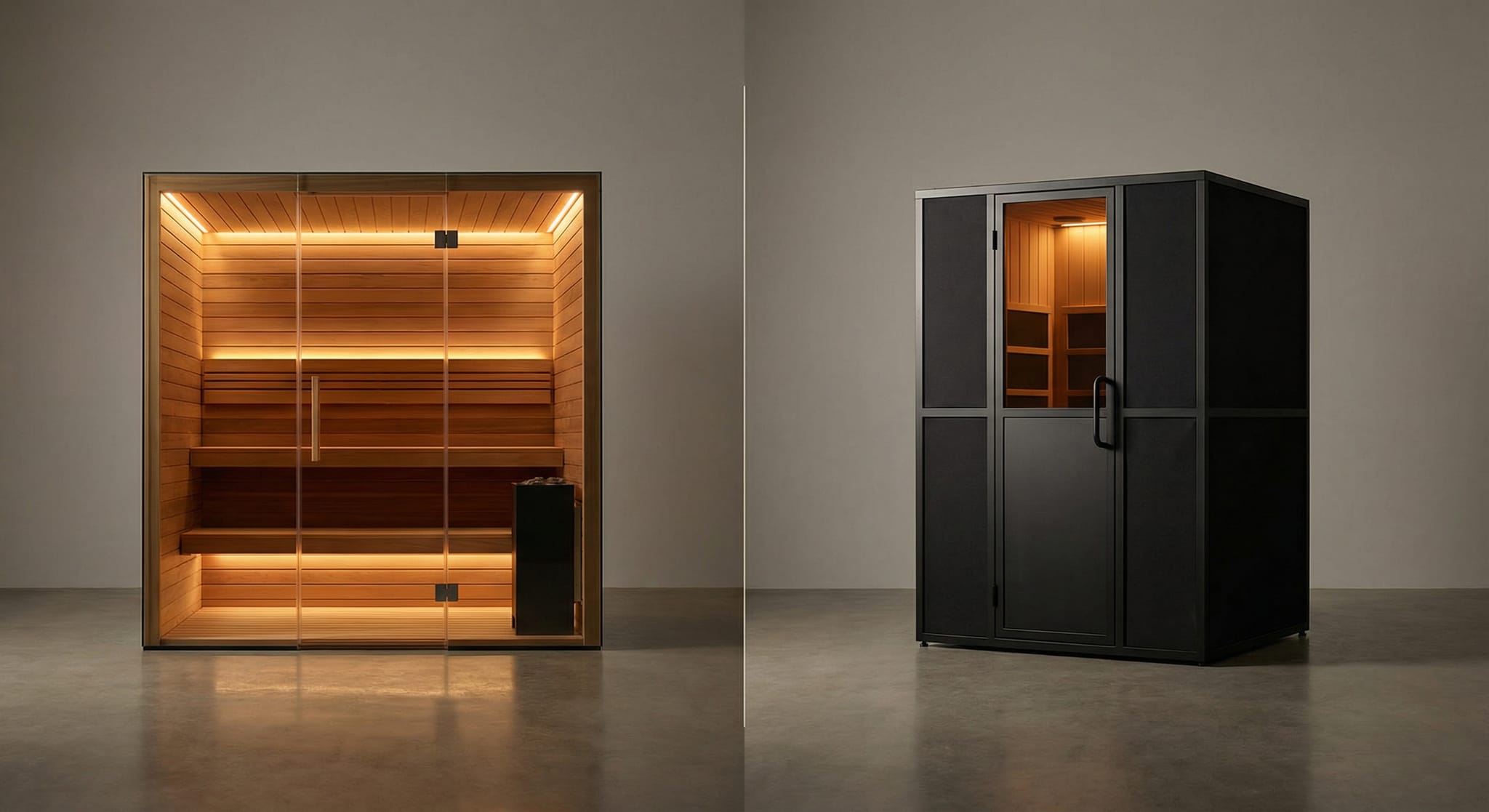
Buying a home sauna sounds simple — until you realize how many options there actually are.
Different heat types. Electrical requirements that vary wildly. Installation headaches nobody warned you about. A confusing landscape of EMF claims, warranty small print, and review sites that are really just thinly veiled storefronts. It's genuinely easy to make a decision that looks good on paper but doesn't fit your home, your budget, or your lifestyle.
This guide covers the five things that actually matter when choosing a sauna — and a few things most guides skip entirely. Work through each one honestly, and you'll avoid almost all of the common mistakes.
Choose your sauna type — this changes everything
Not all saunas heat your body the same way — and that difference has a profound impact on how they feel, how often you'll actually use them, and how much they cost to run. Most buyers focus on price or aesthetics before they've even settled this question. Don't make that mistake.
Heats the air using a wood-burning or electric stove with hot rocks. Intense dry heat with the option to add steam (löyly) by pouring water on the rocks. The most studied type — decades of Finnish health research backs its use.
Infrared panels heat your body directly rather than the surrounding air. Lower ambient temperature makes it more comfortable for longer sessions. Growing clinical evidence base. Usually plug-and-play — no electrician needed for most models.
Operates at the lowest temperatures but near 100% humidity makes it feel significantly hotter. Sweat doesn't evaporate, so your body retains heat more intensely. Portable versions are the cheapest and easiest entry point.
"The best sauna is the one you'll actually get into every day — not the one with the most impressive spec sheet."
If you're deciding between types, think less about "which is objectively best" and more about what kind of heat experience you'll consistently enjoy. Here's a practical breakdown:
- You want the most evidence-backed option and don't mind intense heat — Traditional sauna
- You prefer a gentler experience and want something that plugs into a standard outlet — Infrared sauna
- You have a budget under $600 and just want to test if sauna works for you — Portable steam sauna or infrared blanket
- You want to use it outdoors in a backyard with a wood fire — Traditional barrel or cabin sauna
- You live in an apartment or small home with limited space — Compact infrared cabin or sauna blanket
Traditional saunas have a 20+ year head start in clinical research. Most of the landmark longevity and cardiovascular studies — including the Finnish cohort research published in JAMA Internal Medicine — used traditional Finnish saunas at 80–100°C. Infrared saunas have a growing evidence base, but they're working with a shorter research history. That doesn't make infrared inferior — it just means you should set expectations appropriately when evaluating health claims.
Check the electrical requirements before you buy
Of all the things that catch buyers off guard, electrical requirements cause the most regret. A sauna can arrive at your door and be entirely unusable because the outlet situation wasn't sorted out beforehand. Electrical work is also one of the biggest hidden costs in the total price of ownership.
Plugs into a standard household outlet, just like a lamp or appliance. No electrician needed. Works in apartments, rentals, and garages with standard wiring.
Needs a dedicated circuit installed by a licensed electrician. Adds $200–$1,000+ to your total cost depending on your home's wiring and panel capacity.
If a product page isn't crystal clear about the power requirements, assume it is not plug-and-play. Many brands bury voltage requirements in a spec table at the bottom of the page, or describe it in terms that require translation ("requires a dedicated 40A circuit" = you need an electrician).
Check whether your home's electrical panel has capacity for a new dedicated circuit. Older homes with 100-amp service panels may need a panel upgrade before you can add a 240V sauna circuit — that upgrade can cost $1,500–$3,500 on its own. If you're buying a 240V sauna, call an electrician before you order and get a quote. Factor that into your total budget before you commit.
The good news: the majority of infrared saunas and all portable steam units run on 110–120V. If you're trying to keep things simple, sticking to infrared largely solves this problem — especially for apartment dwellers or renters who can't modify their electrical systems.
Understand EMF without overcomplicating it
EMF is one of those topics that comes up in almost every sauna conversation — and is often more confusing than it needs to be. It's also a heavily marketed feature, which means the information you find from brands is rarely neutral.
The reality is simple: all electrical devices emit some level of electromagnetic fields. Saunas are no exception. What matters is how much exposure you're getting at normal use distances, and how the product is designed to manage that exposure.
There are three types of EMF relevant to saunas: magnetic fields (MF), electric fields (EF), and body voltage (BV). Most brands that publish EMF data only report one of the three — usually magnetic fields, because those tend to be the lowest. A genuinely low-EMF sauna should have independently verified readings across all three.
Third-party testing is the signal that separates legitimate low-EMF claims from marketing. Brands that have their EMF independently measured and publish the full results — not just cherry-picked readings — are meaningfully different from brands that just use "low EMF" as a bullet point. Also note: EMF exposure drops off quickly with distance, so heater placement inside the cabin matters as much as the raw numbers.
You don't need to be obsessed with this — but you should make sure the brand has thought carefully about it. If the product page has no EMF information at all, treat that as a yellow flag. If it has brand-stated numbers with no methodology or third-party testing, read those numbers with healthy skepticism. If it has independent lab results across all three emission types, that's a brand taking the issue seriously.
For reference: safe exposure guidelines generally suggest staying below 3 milligauss (mG) for extended proximity. The best infrared sauna brands achieve under 1 mG at seat level.
Think through installation and space — be honest
It's easy to fall in love with a sauna online. It's considerably harder when it arrives and doesn't fit where you planned, or when you realize the assembly is far more involved than a product description implied. A few minutes of honest planning here prevents a great deal of frustration.
- Where exactly is it going? Measure the space with actual dimensions in hand, not rough estimates. Account for door swing clearance, ventilation space around the unit, and the path from your front door to the installation location (barrel saunas, in particular, often cannot turn corners easily once assembled).
- Ceiling height matters more than floor space. Most infrared cabins sit between 75–84 inches tall. If you're over 6'2", check the interior ceiling height, not just the exterior — they differ.
- Indoor vs. outdoor? Outdoor traditional saunas need a level foundation (concrete pad or patio pavers), weather protection, and an appropriate heater size for your climate. Outdoor infrared saunas are rare; most are only rated for indoor use regardless of marketing language.
- Can it be delivered to the right room? Multi-person infrared cabins typically ship as panels and weigh 200–400 lbs total. Know whether your delivery includes curbside only, threshold delivery, or white-glove room-of-choice service — and factor in the cost difference if you need the latter.
- How involved is assembly? Portable steam saunas: 10–15 minutes. Infrared panel cabins: 30–60 minutes with two people. Traditional barrel saunas: 2–4 hours with two people, and generic instructions that may not match your specific model. Traditional cabin saunas: often require professional installation.
Most infrared saunas under 3 persons run on standard 110V power and can be set up and taken down without any permanent modification to your home. This makes them genuinely renter-friendly. Traditional saunas almost always require 240V dedicated circuits and a permanent installation — not appropriate for most rental situations without explicit landlord permission. Portable steam saunas and infrared blankets are the cleanest options if you're renting and need full flexibility.
None of these are dealbreakers — but they should be matched against your actual situation rather than ignored. The buyers who end up most satisfied are almost always those who spent ten minutes mapping out the logistics before ordering.
Read reviews like you know what you're doing
Most people either overreact to a single bad review or ignore them entirely. The truth is somewhere in the middle — and learning to read reviews strategically is one of the most underrated skills in any major purchase.
"One bad review could be a fluke. The same complaint appearing across dozens of reviews is the product telling you something."
A single negative review about a cracked panel might be a shipping accident. The same complaint from 15 different buyers is a manufacturing issue. Pattern recognition is what makes reviews useful.
A brand's own website will highlight its best reviews. Cross-reference with Trustpilot, Amazon, Reddit (r/Sauna is particularly candid), and independent review sites to get a balanced picture.
1-star reviews are often written in anger; 5-star reviews are often written in the honeymoon period. 2- and 3-star reviews from thoughtful owners who explain what they like and what disappointed them are the most useful signal.
A brand may have been excellent in 2021 and gone downhill since a manufacturing change or ownership shift. Sort reviews chronologically and look for inflection points where the tone changed.
How a company handles problems is often more revealing than how good the product is when nothing goes wrong. Look specifically for reviews that describe warranty claims, replacements, or customer service interactions after purchase.
Many "review" sites are actually storefronts. If every article on a site concludes with a discount code or affiliate link, the reviews are written to sell, not inform. Reddit and Trustpilot are harder to game.
The r/Sauna subreddit is one of the most candid sources of sauna owner feedback available. Members are predominantly enthusiasts who have owned saunas for years — they have strong opinions, they call out brands by name, and they don't have financial incentives to be positive. Search for any brand you're considering before purchasing. The conversations there will tell you things no product page ever will.
What to expect in the first few months
Most buying guides end at the purchase decision. But a surprising number of sauna owners run into questions or frustrations in the first weeks that they weren't expecting — not because anything is wrong, but because nobody prepared them.
- New wood smell is normal. Most infrared and traditional saunas will produce a noticeable wood smell on the first few uses as the wood heats up for the first time. Leave the door open for 30 minutes after your first couple of sessions. It fades with use.
- Your sessions will feel shorter than expected at first. New users often underestimate how intense the heat feels and exit early. That's completely fine. Start with 10–15 minute sessions and build tolerance gradually. Don't try to replicate a 25-minute gym sauna session on day one.
- Hydration matters more than most people expect. You will sweat significantly — often more than during moderate exercise. Drink 500ml of water before each session and at least as much after. Electrolyte replacement becomes relevant if you're using the sauna daily.
- Temperature calibration takes time. The ambient air temperature your sauna displays is not necessarily the temperature your body experiences. Body temperature, heater placement, and session length all affect the actual thermal experience. Spend your first two weeks finding your preferred settings rather than trying to replicate a specific number.
- Wipe it down after every session. Leave the door ajar for 30 minutes after use to allow moisture to escape. Wipe the bench and floor with a dry towel. This prevents mold and keeps the wood in good condition. It takes two minutes and makes a large difference over years of use.
- Benefits often take 2–4 weeks of consistent use to become noticeable. Most people report better sleep and reduced muscle soreness within two weeks of 4–5 weekly sessions. Cardiovascular and long-term benefits are cumulative — this is a habit, not a treatment.
Final thoughts
A good sauna should fit your life, not complicate it.
Work through these five areas honestly and you'll avoid almost every common mistake buyers make: choosing the wrong heat type for how they actually live, getting blindsided by electrical costs, buying from a brand with unverified safety claims, ordering something that doesn't fit their space, and making decisions based on reviews that were designed to sell rather than inform.
At that point, you're not looking for the "perfect" sauna in the abstract. You're looking for the one that fits your space, your budget, your electrical situation, and — most importantly — the one that you'll actually step into four or five times a week for the next decade.
That's the sauna that delivers results.
Ready to compare specific models?
Our community-backed brand lists cover indoor infrared, outdoor traditional, outdoor infrared, and portable saunas — with real pros, cons, and Reddit references for every pick.