Infrared Sauna vs. Traditional Sauna: Which One Is Right for You?
A research-backed look at how each type of sauna works, what the science actually says, and how to choose based on your goals.
# Infrared Sauna vs. Traditional Sauna: Which One Is Right for You?
Both infrared and traditional saunas produce real, measurable health benefits — but they work differently, run at different temperatures, and the research supporting each type is not equal. Here is an honest breakdown of what the science says.
Sauna use has gone from a niche Finnish tradition to a mainstream wellness practice, and the rise of home-friendly infrared cabins has only accelerated the conversation. If you are trying to decide between the two, you have probably already found a lot of marketing noise. This article cuts through it using peer-reviewed research, clinical reviews, and guidance from major medical institutions.
## How Each Sauna Type Works
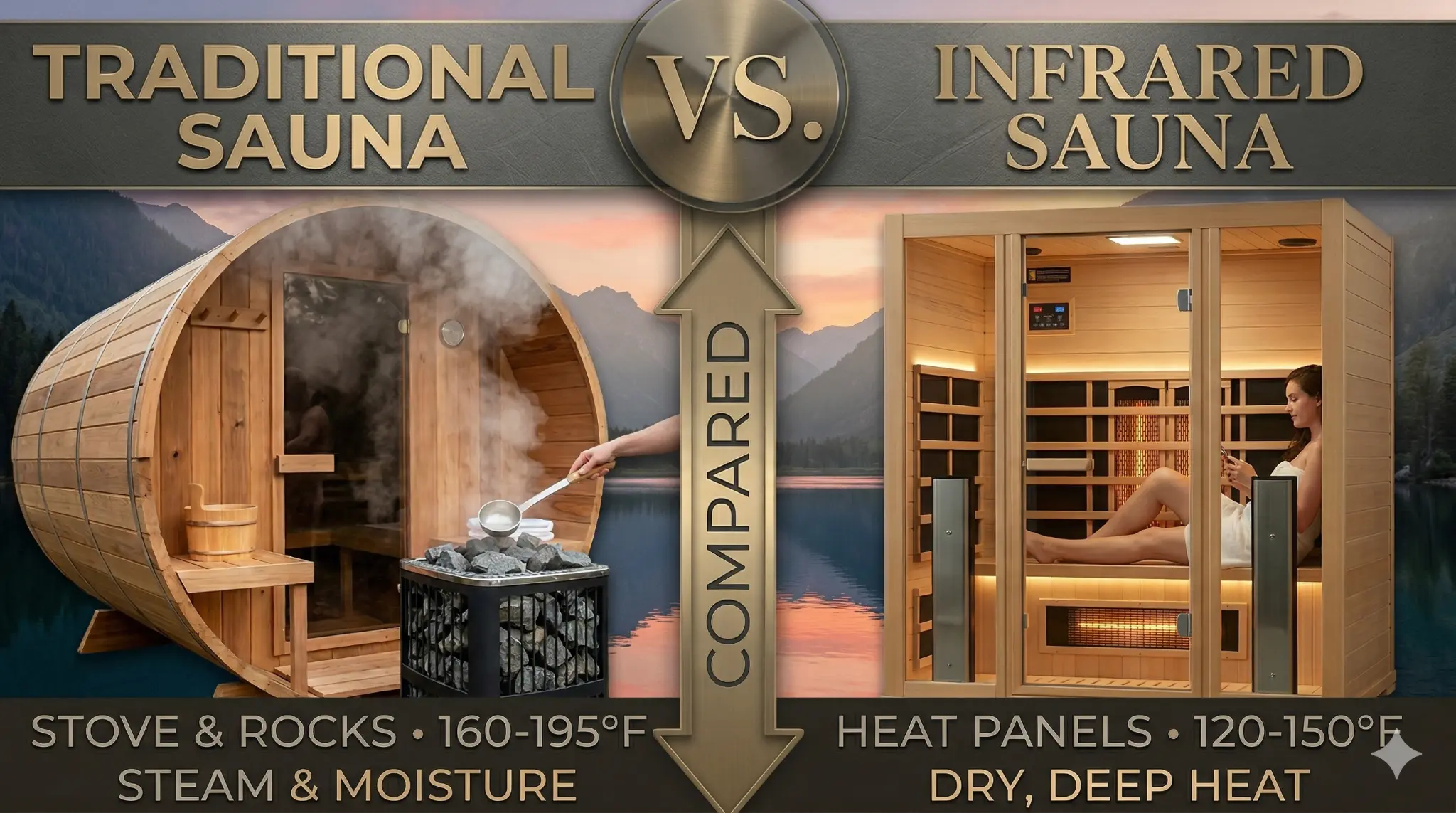
The fundamental difference comes down to *how* heat reaches your body.
**Traditional / Finnish Sauna**
- Heats the air around you using a wood or electric stove topped with rocks
- Temperatures: 80–100°C (176–212°F)
- Humidity: 10–20%, briefly raised by pouring water on rocks
- Sessions typically 5–20 minutes
- Thousands of years of cultural history in Finland
**Infrared / Far-Infrared (FIR) Sauna**
- Uses infrared light emitters that heat the body directly rather than the air
- Temperatures: 45–60°C (110–140°F)
- Very low humidity; no steam or water involved
- Sessions typically 15–30 minutes
- Grew in popularity over the last two decades
Because infrared saunas heat the body more directly, users experience significant sweating at lower air temperatures. This makes them easier to tolerate for people who find extreme heat uncomfortable or unsafe. The lower temperature also means the surrounding air is not as taxing on the respiratory system.
## Cardiovascular Health and Longevity
This is where the evidence is strongest — and where traditional saunas have a significant research advantage, simply because they have been studied far longer.
The landmark dataset comes from the [Kuopio Ischaemic Heart Disease Risk Factor Study](https://jamanetwork.com/journals/jamainternalmedicine/fullarticle/2130724), published in *JAMA Internal Medicine* in 2015. Researchers followed 2,315 Finnish men aged 42–60 for an average of 20 years. The findings were striking: men who used a sauna four to seven times per week had a **63% lower risk of sudden cardiac death** and a **40% lower risk of all-cause mortality** compared to those who used it just once a week. [Harvard Health](https://www.health.harvard.edu/blog/sauna-use-linked-longer-life-fewer-fatal-heart-problems-201502257755) covered this study and noted that the cardiovascular effects mirror those of moderate-intensity exercise.
**Key statistics from the Finnish cohort study:**
- **63%** lower risk of sudden cardiac death with 4–7 sauna sessions/week vs. one
- **40%** reduction in all-cause mortality for frequent Finnish sauna users
- **20 years** average follow-up period in the main Finnish cohort study
These are observational results — they show association, not definitive causation — but they are consistent across multiple large studies and have been reviewed in [Mayo Clinic Proceedings](https://www.mayoclinicproceedings.org/article/s0025-6196(18)30275-1/fulltext) as some of the most compelling data on passive heat therapy and health.
For infrared saunas, the cardiovascular evidence is more limited but promising. A [review published in *Canadian Family Physician*](https://pmc.ncbi.nlm.nih.gov/articles/PMC2718593/) found preliminary but meaningful support for far-infrared sauna therapy in people with congestive heart failure, with improvements in cardiac function markers. A [2021 randomized controlled crossover trial](https://www.sciencedirect.com/science/article/pii/S0965229921001394) found that an infrared sauna session elevated core body temperatures and produced cardiovascular responses comparable to moderate exercise in healthy women.
> **The research gap is real, but narrowing.** Traditional saunas benefit from decades of large cohort studies. Infrared saunas are newer and have mostly been studied in smaller clinical trials focused on specific conditions. Both types appear to support cardiovascular health, but the strength of evidence is currently not equivalent.
## Brain Health and Dementia Risk
One of the most compelling findings in sauna research involves the brain. The same Finnish cohort that yielded the cardiovascular data was later analyzed for dementia outcomes. Published in [*Age and Ageing* (Oxford Academic)](https://academic.oup.com/ageing/article/46/2/245/2654230), the study found a strong inverse relationship between sauna frequency and dementia risk: men who bathed four to seven times per week had a **66% lower risk of dementia** and a **65% lower risk of Alzheimer's disease** compared to those who bathed once weekly.
A subsequent longer study of nearly 14,000 Finnish men and women followed for up to 39 years confirmed a similar association, according to a [review by the Alzheimer's Drug Discovery Foundation](https://www.alzdiscovery.org/cognitive-vitality/blog/can-using-the-sauna-reduce-risk-for-alzheimers-disease). Researchers believe the protective effect may operate through improved vascular function, reduced systemic inflammation, and lower blood pressure — all known risk factors for cognitive decline.
It is worth noting that almost all dementia-related sauna research has been done with traditional Finnish saunas, and most studies involved Finnish populations with lifelong sauna habits starting in childhood. Whether the benefits apply equally to people who take up sauna use in adulthood, or whether they apply to infrared sauna users, remains an open question.
## Pain, Recovery, and Chronic Conditions
This is one area where infrared saunas have more dedicated research — particularly for musculoskeletal and fatigue-related conditions. The [first systematic review to compare both Finnish and infrared saunas side by side](https://pmc.ncbi.nlm.nih.gov/articles/PMC5941775/), published in *Evidence-Based Complementary and Alternative Medicine*, found that infrared sessions made up the majority of clinical trials investigating chronic pain, fibromyalgia, and rheumatic conditions.
Key findings from that review and associated trials:
- A 12-week program combining infrared sauna with underwater exercise significantly reduced pain in women with fibromyalgia.
- Four weeks of infrared sauna reduced pain and stiffness in patients with rheumatoid arthritis and ankylosing spondylitis.
- A [2021 crossover trial](https://www.sciencedirect.com/science/article/pii/S0965229921001394) showed that infrared sessions elevated core body temperature more than exercise at comparable intensity, suggesting potential for muscle recovery.
- A 2023 study in *Biology of Sport* found that a post-exercise infrared sauna session improved neuromuscular recovery and reduced muscle soreness after resistance training.
Traditional saunas also relax muscles and reduce stiffness — particularly through the combination of heat and cooling cycles — but the targeted research on chronic pain populations has more often used infrared protocols, largely because the lower temperatures make participation easier for people already experiencing discomfort.
## Practical Differences: Temperature, Cost, and Installation
Beyond health outcomes, the day-to-day experience of these two sauna types differs considerably.
### Temperature and Comfort
Traditional saunas run hot enough to noticeably challenge the cardiovascular system. Many people find this invigorating; others find it difficult or claustrophobic, especially at the start. Infrared saunas run at roughly half the ambient temperature, making them easier to tolerate for longer sessions. For people with heat sensitivity, low blood pressure, or respiratory conditions, this difference is significant.
### Installation and Cost
Traditional saunas require proper ventilation, a water-resistant interior, and typically a higher-voltage electrical connection or plumbing for steam. Home units typically start around $3,000–$6,000 for a quality build, with commercial or custom installations running substantially higher. Infrared sauna cabins are generally easier to install — many plug into a standard 120V outlet — and cost between $1,500 and $5,000 for home units, with some compact two-person models available under $2,000.
### Energy Use
Infrared saunas heat up in 10–15 minutes and use less energy per session. Traditional saunas typically need 20–30 minutes to reach temperature and draw more power, especially in larger rooms.
### The Social and Sensory Experience
There is a cultural dimension to traditional sauna bathing that no infrared comparison chart can fully capture. The ritual of heating rocks, adding water (löyly), alternating between intense heat and cold water immersion, and often sharing the space with others has a deeply communal and psychological dimension documented across Finnish research on wellbeing. Infrared saunas tend to be a more solitary, controlled experience.
## Who Should Choose Which?
**Traditional sauna may suit you better if…**
- You want the most robust long-term research behind your choice
- You enjoy the intense heat and steam ritual
- Cardiovascular conditioning and longevity are your main goals
- You have access to a gym, spa, or community facility
- You plan to combine sauna with cold plunge or social bathing
- Budget is not a limiting factor
**Infrared sauna may suit you better if…**
- You are sensitive to extreme heat or have mild respiratory issues
- You are managing chronic pain, fibromyalgia, or joint conditions
- You want a home unit that is easy to install
- You prefer longer, gentler sessions with less cardiovascular intensity
- Muscle recovery after training is a primary goal
- You are new to sauna use and want to ease in gradually
A review in [*Temperature* (Taylor & Francis, 2024)](https://pmc.ncbi.nlm.nih.gov/articles/PMC10989710/) summarized the current scientific consensus neatly: traditional Finnish saunas have more extensive research, but other passive heat therapies including infrared saunas are increasingly studied and show real benefits. The honest answer for most healthy adults is that the best sauna is the one you will actually use consistently.
## Safety and Precautions
Both types of sauna are safe for most healthy adults when used appropriately. There are, however, meaningful situations where caution or medical clearance is warranted.
### Who Should Consult a Doctor First
- Anyone with a diagnosed heart condition, particularly unstable angina or severe aortic stenosis
- People with low blood pressure or a history of fainting
- Those taking medications that affect cardiovascular function or temperature regulation
- Pregnant individuals (both types should generally be avoided, especially in the first trimester)
- People with multiple sclerosis or adrenal suppression, as elevated core temperature can temporarily worsen symptoms
### General Safety Guidelines
- **Hydration:** Drink water before, during, and after every session. Sweating can cause significant fluid loss.
- **Session length:** Start with 10–15 minutes and build gradually. Avoid exceeding 20–30 minutes in a single session without a break.
- **Avoid alcohol:** Alcohol impairs temperature regulation and significantly increases risk of heat-related illness in saunas of both types.
- **Listen to your body:** Dizziness, nausea, or significant discomfort are signs to exit immediately and cool down slowly.
- **Cool down gradually:** Avoid jumping immediately from intense heat into very cold water if you are new to the practice or have any cardiovascular concerns.
The [Mayo Clinic notes](https://www.mayoclinic.org/healthy-lifestyle/consumer-health/expert-answers/infrared-sauna/faq-20057954) that infrared saunas are generally well-tolerated and that no major adverse reactions have been found in clinical use when guidelines are followed. The same applies to traditional saunas for healthy adults, with the caveat that the higher temperatures place greater immediate demand on the cardiovascular system.
---
## The Bottom Line
Traditional Finnish saunas have a decades-long research track record linking frequent use to lower rates of cardiovascular death, dementia, and all-cause mortality. That evidence base is substantial and supported by large prospective cohort studies published in top-tier journals. If longevity data matters to you, the weight of research currently favors the traditional sauna.
Infrared saunas offer a gentler, more accessible heat experience with real clinical evidence behind specific applications — particularly for chronic pain, joint conditions, muscle recovery, and people who cannot tolerate high temperatures. The research is younger and the studies are smaller, but they are accumulating.
For most people who are generally healthy and motivated to build a consistent sauna habit, either type will deliver meaningful benefits. The key variables are your specific health goals, your tolerance for heat, your budget, and — perhaps most importantly — which option you will actually commit to using several times a week over the long term.
> **A practical suggestion:** If you have access to both through a gym or wellness center, try each for a few weeks and track how you feel. Recovery, sleep quality, and stress levels are all reasonable self-assessments. If you are buying for home use, infrared is typically the easier entry point. If you are building or renovating and cost is secondary, a traditional sauna provides access to the strongest body of evidence.
---
## References and Further Reading
1. Laukkanen T, Khan H, Zaccardi F, Laukkanen JA. *Association between sauna bathing and fatal cardiovascular and all-cause mortality events.* JAMA Internal Medicine, 2015. [jamanetwork.com](https://jamanetwork.com/journals/jamainternalmedicine/fullarticle/2130724)
2. Laukkanen JA, Laukkanen T, Kunutsor SK. *Cardiovascular and Other Health Benefits of Sauna Bathing: A Review of the Evidence.* Mayo Clinic Proceedings, 2018. [mayoclinicproceedings.org](https://www.mayoclinicproceedings.org/article/s0025-6196(18)30275-1/fulltext)
3. Laukkanen T, Kunutsor S, Kauhanen J, Laukkanen JA. *Sauna bathing is inversely associated with dementia and Alzheimer's disease in middle-aged Finnish men.* Age and Ageing, 2017. [academic.oup.com](https://academic.oup.com/ageing/article/46/2/245/2654230)
4. Beever R. *Far-infrared saunas for treatment of cardiovascular risk factors: Summary of published evidence.* Canadian Family Physician, 2009. [pmc.ncbi.nlm.nih.gov](https://pmc.ncbi.nlm.nih.gov/articles/PMC2718593/)
5. Cohen M et al. *Clinical Effects of Regular Dry Sauna Bathing: A Systematic Review.* Evidence-Based Complementary and Alternative Medicine, 2018. [pmc.ncbi.nlm.nih.gov](https://pmc.ncbi.nlm.nih.gov/articles/PMC5941775/)
6. Kunutsor SK et al. *The multifaceted benefits of passive heat therapies for extending the healthspan.* Temperature (Taylor & Francis), 2024. [pmc.ncbi.nlm.nih.gov](https://pmc.ncbi.nlm.nih.gov/articles/PMC10989710/)
7. Denton EJ et al. *Infrared sauna as exercise-mimetic? Physiological responses to infrared sauna vs exercise in healthy women.* Complementary Therapies in Medicine, 2021. [sciencedirect.com](https://www.sciencedirect.com/science/article/pii/S0965229921001394)
8. Sauna use linked to longer life, fewer fatal heart problems. Harvard Health Blog, 2015. [health.harvard.edu](https://www.health.harvard.edu/blog/sauna-use-linked-longer-life-fewer-fatal-heart-problems-201502257755)
9. Do infrared saunas have any health benefits? Mayo Clinic. [mayoclinic.org](https://www.mayoclinic.org/healthy-lifestyle/consumer-health/expert-answers/infrared-sauna/faq-20057954)
10. Can using the sauna reduce risk for Alzheimer's disease? Alzheimer's Drug Discovery Foundation. [alzdiscovery.org](https://www.alzdiscovery.org/cognitive-vitality/blog/can-using-the-sauna-reduce-risk-for-alzheimers-disease)
11. Infrared Sauna vs. Traditional Sauna: Which Is Better? GoodRx Health. [goodrx.com](https://www.goodrx.com/well-being/alternative-treatments/infrared-sauna-vs-traditional-sauna)
---
*Medical disclaimer: This article is for informational purposes only and does not constitute medical advice. Always consult a qualified healthcare provider before starting any new wellness practice, particularly if you have an existing health condition or take prescription medications.*